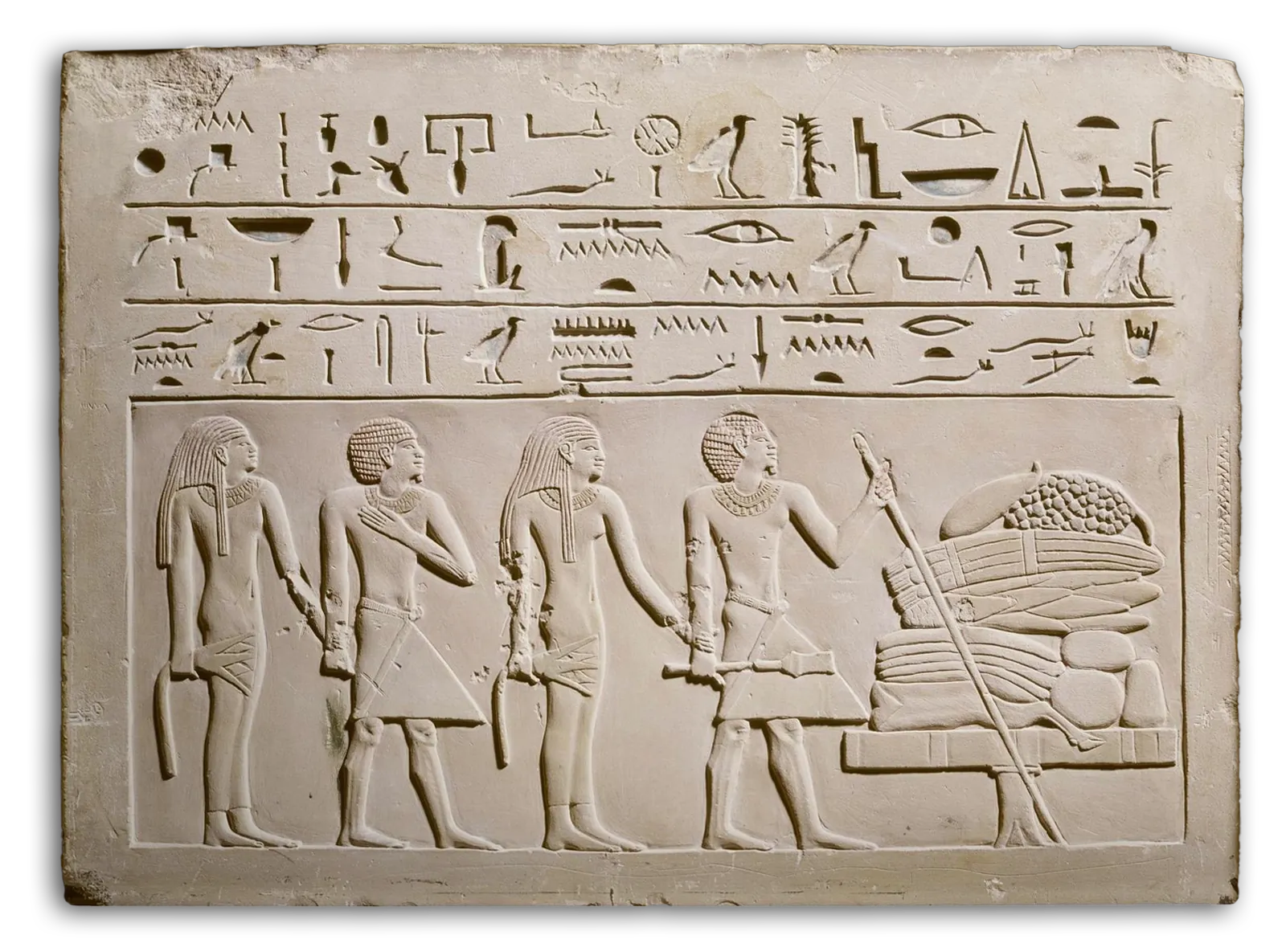
This limestone stela – now part of the Egyptian collection at the Rijksmuseum van Oudheden in Leiden – once stood among countless others at Abydos, one of ancient Egypt’s most important sites associated with Osiris, god of the afterlife. Wealthy Egyptians often built chapels and erected stelae there in the hope of participating in the eternal rituals honoring Osiris.
The stela depicts an official named Khu  in raised relief, accompanied by members of his family. It names his wife, Senet
  , his brother, Mentuwoser
  and their mother — also named Senet . Their names were not incidental: by including them in the offering formula, the inscription allowed them to participate in its benefits as well.
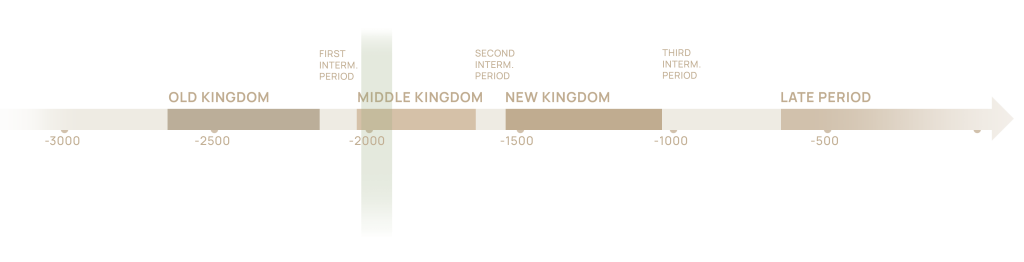
Based on its style and orthographic features, the stela was most likely created during the reign of Senusret I (c. 1920–1875 BCE) in the early 12th Dynasty of the Middle Kingdom. This was also the period in which Middle Egyptian reached its classical form, making inscriptions from the 12th Dynasty particularly important for understanding the language.

Reading the inscription
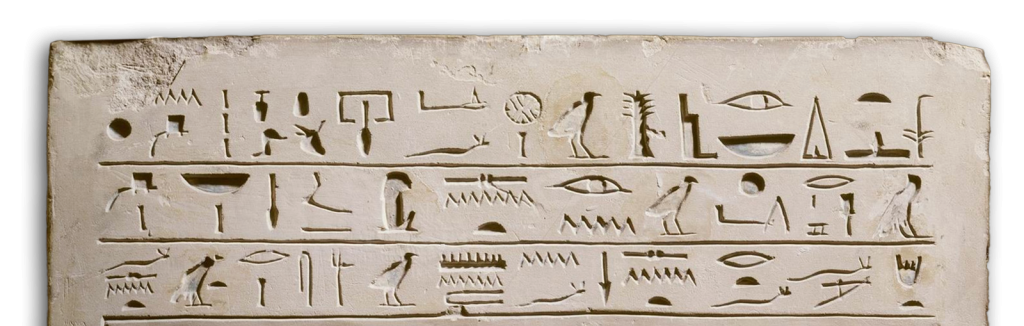

The top register consists of three horizontal lines of hieroglyphs which are to be read from right to left.
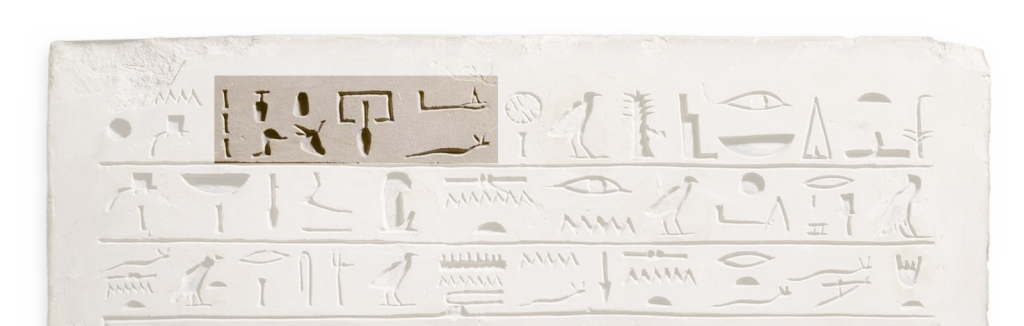
The inscription is a classic offering formula – a ritual text intended to provide the deceased with bread, beer, meat and other necessities in the afterlife. We can recognize it from its opening,  Htp-di-nswt.
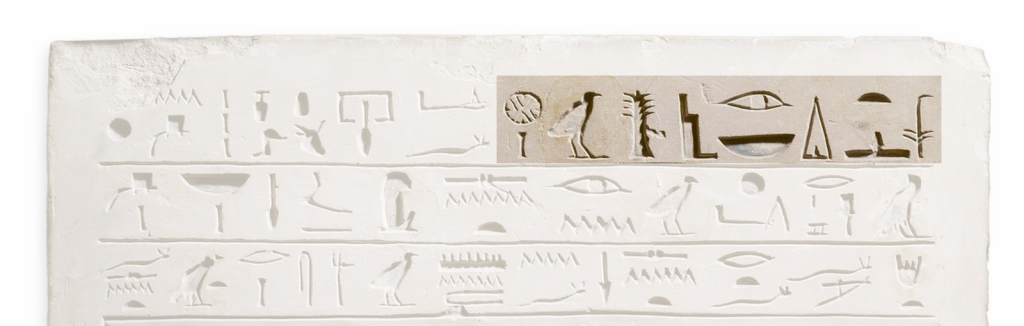

The formula begins by naming those responsible for providing the offering: first the king and then the god Osiris followed by one of his common epithets (lord of Djedu).
Htp-di-nswt an offering which the king gives
 Htp-di-nswt is a fossilized expression whose original grammar is not entirely clear. It most likely consists of a noun
  Htp (offering) followed by a relative clauseA clause is a group of words that has a subject and a verb. It can be a part of a sentence. EXAMPLE: I sailed upstream because His Majesty had ordered it. with sDm=f (di nswt). Taken literally, the phrase can be understood as “an offering, the one which the king gives”. The element
  nswt (king) is written first because of the honorific transposition.
 wsir Osiris (god’s name)
 nb lord – the sign is visually arranged between the two signs for Osiris to fit the available space, but grammatically belongs to the phrase “lord of Djedu”.
 Ddw Djedu – an ancient Delta town, identified with modern Abusir el-Bana, and a major cult center of Osiris alongside Abydos

Next we have the list of offerings, introduced by the phrase  prt-xrw, traditionally translated as “voice offering” or “invocation offering”. On this stela, the offering consists of bread, beer, oxen and fowl.
 di=f may he (Osiris) give – this is a verb form called sDm=f. It consists of the verb
  rdi (“to cause, to give”) and the suffix pronounA suffix pronoun is a pronoun attached to the end of another word. It can mean “my”, “your”, “his”, etc. For example, pr=f means “his house”.
  =f (“he, him, his”) as its subject.
The sDm=f form is used here with a subjunctiveSubjunctive is a verb form used for an action that is wanted, intended, commanded, etc. It can often be translated “may” or “should". meaning, specifically, expressing a wish. Compared to the other forms of sDm=f, the subjunctiveSubjunctive is a verb form used for an action that is wanted, intended, commanded, etc. It can often be translated “may” or “should". is not introduced by an initial particle (such as  iw or
iw or  m=k). The irregular verb rdi usually loses its initial
  r in this form.
prt-xrw a voice offering – lit. “coming forth of the voice”
Commonly written with the bread and beer signs incorporated,  prt-xrw is a compound nounA compound noun is a noun made by combining two or more words to create one meaning. consisting of the infinitiveThe infinitive expresses an action in general (to do, to see, to speak). In translation, the -ing (gerund) form (doing, seeing, speaking) may fit better.
  prt “coming forth” + the noun
  xrw “voice”. Both words are shortened and arranged visually into . Because
  pri “to come forth” is a weak verb, it shows a
  -t ending in infinitiveThe infinitive expresses an action in general (to do, to see, to speak). In translation, the -ing (gerund) form (doing, seeing, speaking) may fit better..
 t Hnqt kAw Apdw bread, beer, oxen (and) fowl
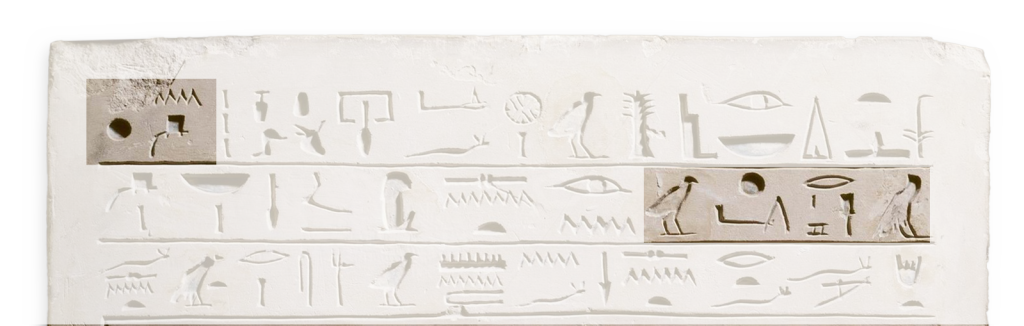

The formula now identifies the person who is to receive the offering, giving his title, name and status among the revered dead –  imAx(w). We learn that he was an
  imy-r w – a district overseer. This title appears to be associated with the treasury/provisioning sector, temples, or other institutions. Specifically,
  w refers to an administrative district or unit that was attached to a larger institution and whose official could perform various administrative, legal, and supervisory duties.
 n to (prepositionA preposition tells how things relate in space or time. EXAMPLE: “The Ba is in the sky”)
imAx(w) revered one
imy-r w overseer of the district (title)
xw Khu (name) – a fairly common ancient Egyptian name that means “(he) who is protected” or “the protected one”. The name derives from the verb  xwi (“to protect”).
What we have here is a passiveThe passive focuses on what happened to someone or something, rather than who did it. “The temple was built” is passive. participle used as a noun. A passiveThe passive focuses on what happened to someone or something, rather than who did it. “The temple was built” is passive. participle is a verb form that describes someone or something as the recipient of the action. Verbs ending in a “weak” consonant, such as xwi, sometimes show additional endings in their participial forms, such as  w or
w or  y. In masculine nouns, these endings are usually omitted in writing. They can, however, become visible in feminine forms before the feminine ending t, such as in the name
  xwyt “(she) who is protected”.
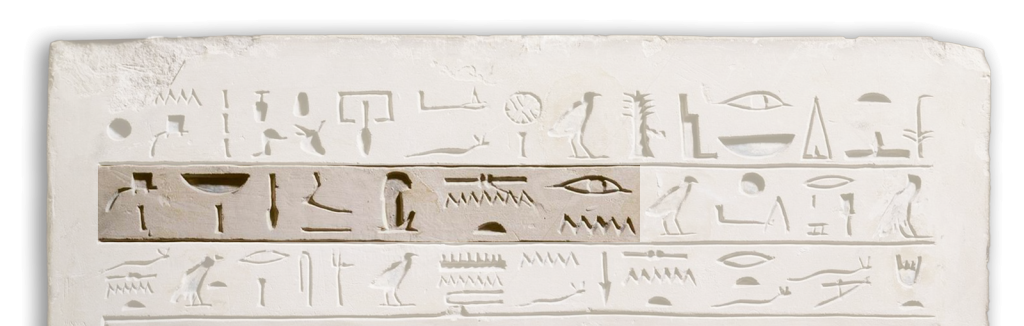

More information about Khu follows – his mother’s name and the phrases that identify him as a revered individual who earned his right to enjoy the afterlife.
 ir.n born of – lit. “whom … made”
This construction is a past relative formPast relative form is a verb form used to describe a noun by saying what it did in the past, such as “the temple that the king built”. (also called relative clauseA clause is a group of words that has a subject and a verb. It can be a part of a sentence. EXAMPLE: I sailed upstream because His Majesty had ordered it. with sDm.n=f). It takes the gender and number of the noun it refers to, which is in this case masculine singular (Khu).
 snt Senet (name)
 mAa-xrw true of voice
 nb imAx possessor of reverence
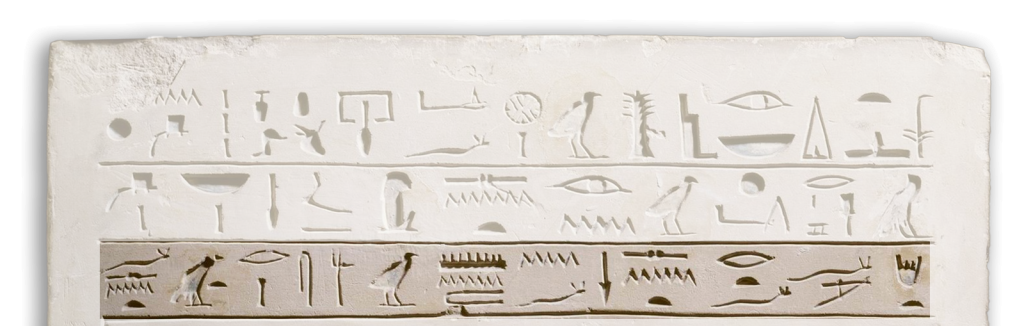


Khu’s family members are listed in the final line of the inscription and depicted in the same order, from right to left, in the register below.
 Hmt=f his wife
 mrt=f his beloved
This is a relative form (or a relative clauseA clause is a group of words that has a subject and a verb. It can be a part of a sentence. EXAMPLE: I sailed upstream because His Majesty had ordered it. with sDm=f). Lit. “(the one) whom he loves”
snt Senet (name)
 sn=f his brother
mnTw-wsr Mentuwoser (name) – it means “(god) Montu is powerful” (subject + stativeStative is a verb form that describes a state or condition, rather than an action. For example, “he is (in a state of being) happy” or “the door is closed". construction).
 mwt=f his mother – although the loaf t would normally follow the vulture mwt as a phonetic complement, it has been placed before the sign to fit the available space.
snt Senet (name)
Putting the pieces together
hieroglyphs:

transliteration:
Htp-di-nswt wsir nb Ddw di=f prt-xrw t Hnqt kAw Apdw n imAx(w)
imy-r w xw ir.n snt maA-xrw nb imAx
Hmt=f mrt=f snt sn=f mnTw-wsr mwt=f snt
translation:
“An offering which the king gives (and) Osiris, lord of Djedu:
may he (Osiris) give a voice offering of bread, beer, oxen and fowl
to the revered overseer of the district, Khu,
born of Senet, true of voice, possessor of reverence;
his beloved wife Senet, his brother Mentuwoser, his mother Senet.”
bibliography:
- Allen, James P. (2014). Middle Egyptian: An Introduction to the Language and Culture of Hieroglyphs, 3rd Edition. Cambridge University Press.
- Franke, D. (2003). The Middle Kingdom Offering Formulas—A Challenge. The Journal of Egyptian Archaeology, 89(1), 39-57.
- Ward, William A. (1982). Index of Egyptian Administrative and Religious Titles of the Middle Kingdom. American University in Beirut, p. 41.
- Russo, Barbara. (2017). The Territory w and Related Titles during the Middle Kingdom and Second Intermediate Period. Golden House Publications.
- https://hdl.handle.net/21.12126/22540 – RMO, AP 71 – Stèle van Choe
abydos middle kingdom offering formula rijskmuseum van oudheden stela