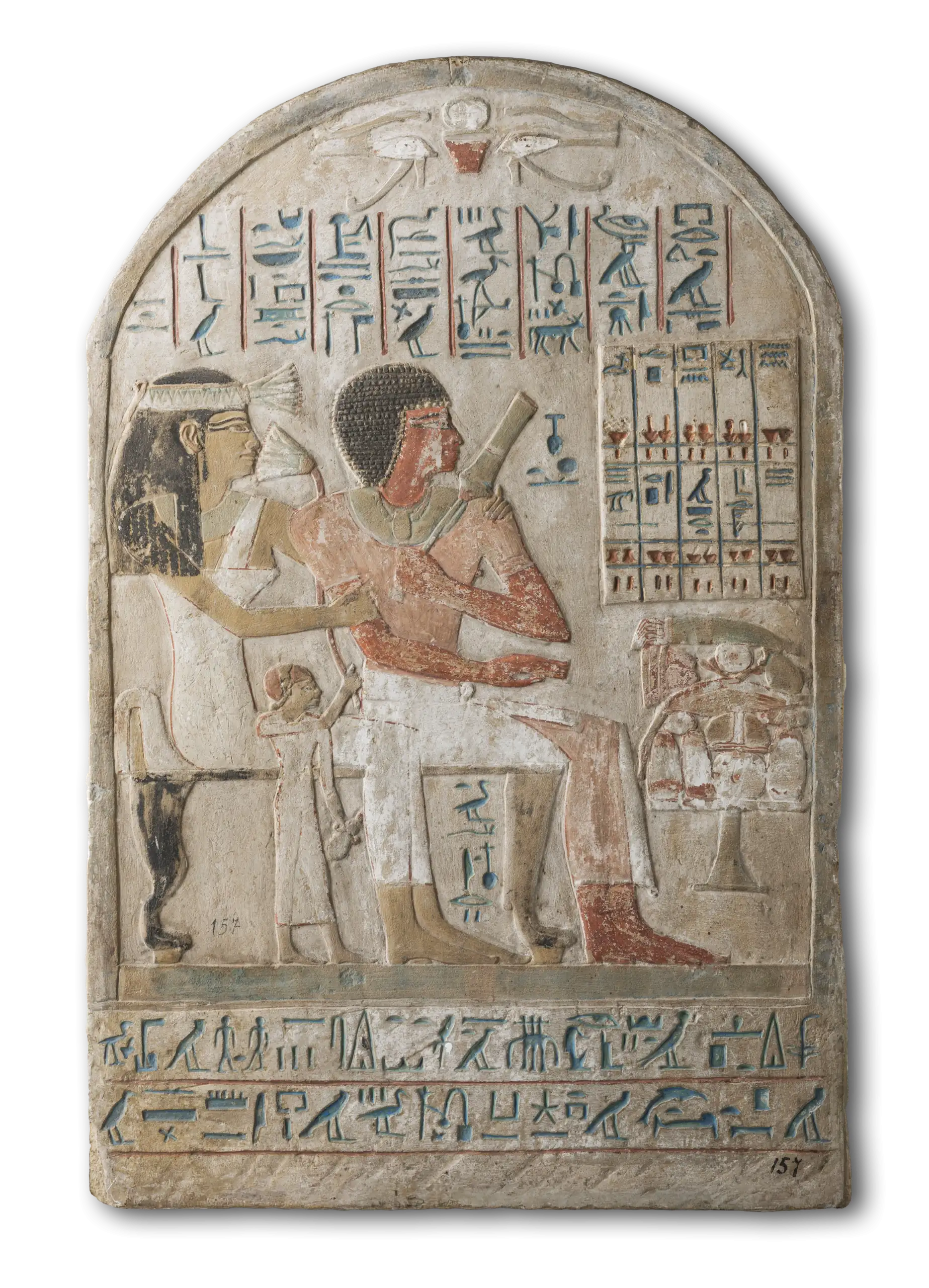
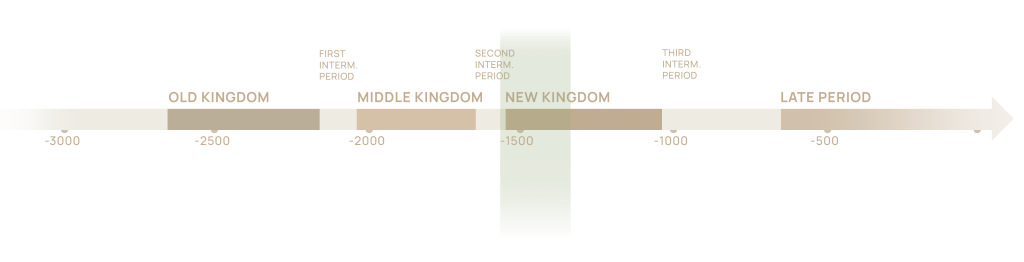
This beautifully preserved round-topped stela (Cat. 1638) dates back to the early 18th Dynasty of the New Kingdom (c. 1550-1300 BCE) and depicts a seated couple – Djehutynefer  called Seshu
  and his wife Benbu
  receiving offerings. Their daughter Nefertari
  stands at their feet holding a lotus flower and a mirror. The man wears a white kilt and holds a staff of authority, which are important symbols of his high status. Both adults wear wigs and jewelry typical of elite fashion at the time. To the right of them is an offering table and a detailed list of offerings. In front of the group is a caption
  smA xt, meaning “partaking of the offerings”.
Above and below the central scene are inscriptions rendered in sunk relief and painted in blue against a white background. They feature a deceased’s wish to go out and see the sun disc and a  Htp-di-nswt offering formula invoking deities to ensure provisions in the afterlife.
What makes this stela particularly interesting is that the tomb it came from has been lost. It has been tentatively linked to TT A6, a rock-cut tomb at Dra Abu el-Naga in Thebes, which has also disappeared. But the identification is uncertain: although the owner of TT A6 was named Djehutynefer (which was a common name at the time), we cannot be sure that he was the same Djehutynefer as the man shown on this stela, since the surviving names and titles do not match clearly enough.
Fortunately, a few other objects help us piece together his family: another stela in Museo Egizio in Turin (Cat. 1639) was dedicated by his son Mahu  , a double statue of Djehutynefer and his wife is now in the Louvre (A55/A56) and a sandstone door jamb in the Metropolitan Museum of Art (MMA 30.6.43) also depicts the couple. Funerary cones (Louvre E 19977 Bis, E 19978 Bis, Davies n. 397 etc.) even preserve the name of his father, the scribe Mesu
  . Scattered across museums today, these objects offer rare glimpses of a tomb and a family whose story would otherwise have been lost.

Part 1 – UPPER REGISTER
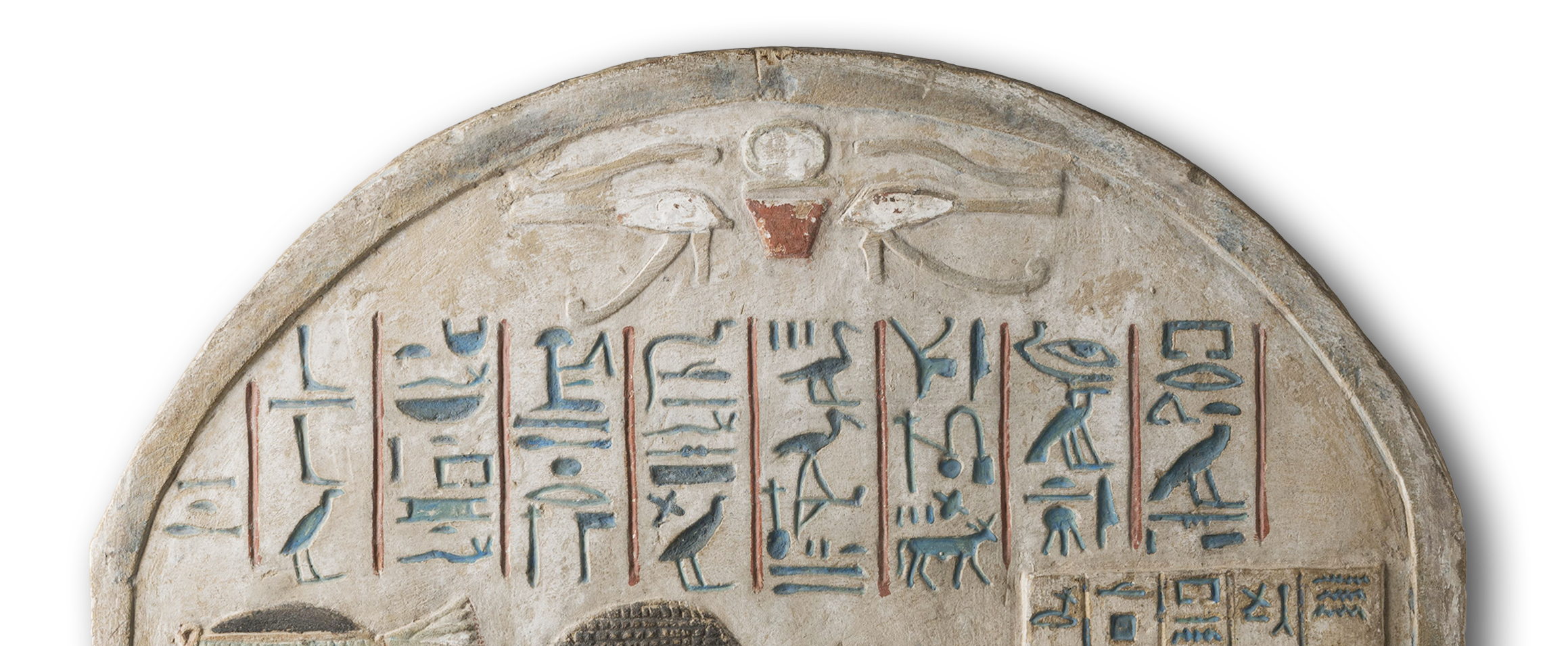

We can now turn to the stela itself, beginning at the very top with its lunette (the rounded top portion of a stela). Here a pair of  wDAt eyes flank a
  Sn ring, with an image of
  iab vessel below. The higher position of the Sn sign gives away that this is an early New Kingdom stela. The upper register contains nine columns of hieroglyphs, which we read from right to left.
Reading the inscription
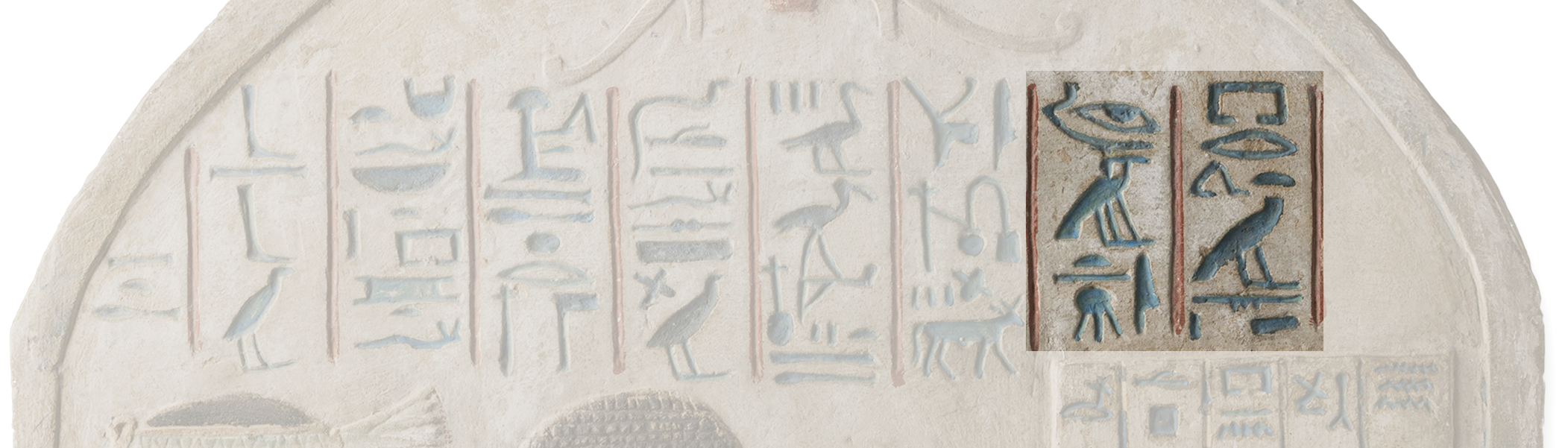

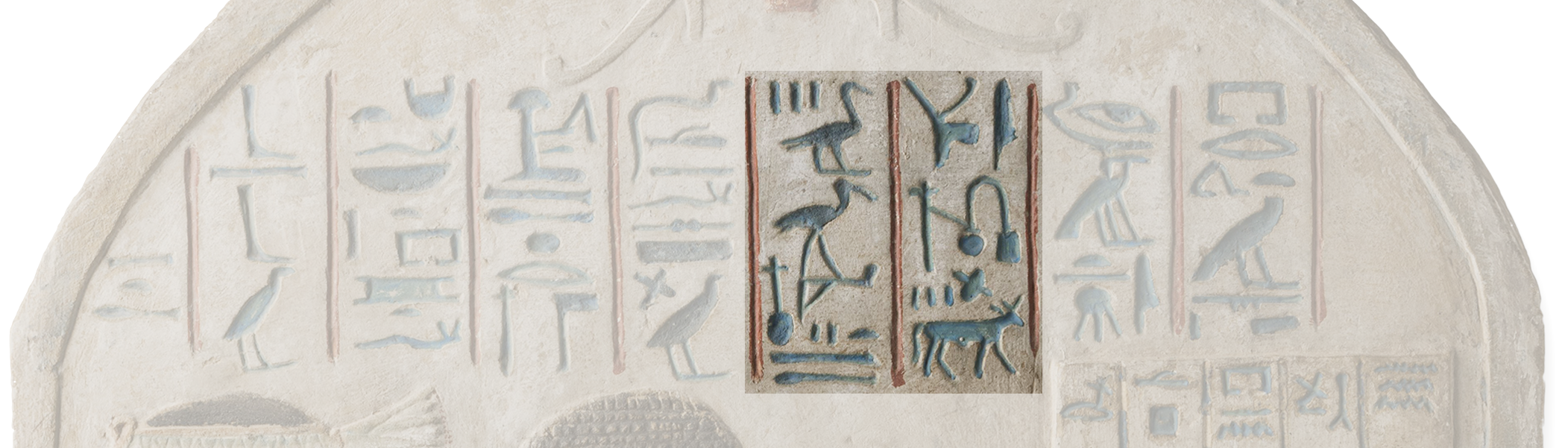
prt m tA (r) mAA itn
Coming forth from the earth (in order to) see the sun disk
 prt coming forth – infinitiveThe infinitive expresses an action in general (to do, to see, to speak). In translation, the -ing (gerund) form (doing, seeing, speaking) may fit better. of the verb pri “to come forth” / “to emerge”

InfinitiveThe infinitive expresses an action in general (to do, to see, to speak). In translation, the -ing (gerund) form (doing, seeing, speaking) may fit better. is often used in headings – as a caption to a painted scene.  pri is a verb with a “weak” final consonant (3ae-inf.). This category of verbs shows a
  -t ending in the infinitiveThe infinitive expresses an action in general (to do, to see, to speak). In translation, the -ing (gerund) form (doing, seeing, speaking) may fit better..
 m tA from the earth – adverbial phrase consisting of a prepositionA preposition tells how things relate in space or time. EXAMPLE: “The Ba is in the sky”
  m “in” / “from” and a noun
  tA “land” / “earth”
 (r) mAA (in order to) see –
  mAA is a geminatingA geminating verb doubles a consonant sound when it’s changed or used in certain forms. verb (2ae-gem.) – a verb with the doubling last consonant (here written with a compressed
  AA sign). This category of verbs doesn’t have the -t ending in the infinitiveThe infinitive expresses an action in general (to do, to see, to speak). In translation, the -ing (gerund) form (doing, seeing, speaking) may fit better.. The same phrase occurs in other inscriptions from the same period as
  r mAA so we can assume that the prepositionA preposition tells how things relate in space or time. EXAMPLE: “The Ba is in the sky”
  r is simply omitted here.
r followed by an infinitiveThe infinitive expresses an action in general (to do, to see, to speak). In translation, the -ing (gerund) form (doing, seeing, speaking) may fit better. is used to indicate purpose (“in order to…”). Grammatically, it is also possible that this is another bare infinitiveThe infinitive expresses an action in general (to do, to see, to speak). In translation, the -ing (gerund) form (doing, seeing, speaking) may fit better. in a sequence (“emerging from the earth, seeing the sun disc”), but the logical connection between these two clausesA clause is a group of words that has a subject and a verb. It can be a part of a sentence. EXAMPLE: I sailed upstream because His Majesty had ordered it. is one of purpose, with the second action serving as the intended goal of the first.
 itn the sun disc – the object of the infinitiveThe infinitive expresses an action in general (to do, to see, to speak). In translation, the -ing (gerund) form (doing, seeing, speaking) may fit better. mAA; The word for “sun disc” is traditionally written with the simple sun determinativeA determinative is a sign placed at the end of a word to help show what the word means or what kind of thing it refers to.
  , and rarely with the combination of sun and rays of sunshine
  (N8 – determinativeA determinative is a sign placed at the end of a word to help show what the word means or what kind of thing it refers to. for “sunshine” / “radiance”) which we see here. It is important to note that this inscription predates the Amarna period and should not be confused with the spelling used for the god Aten. Also, notice that almost every n sign in this text is written with a simple horizontal line
  , instead of the zigzag water line
  .
.

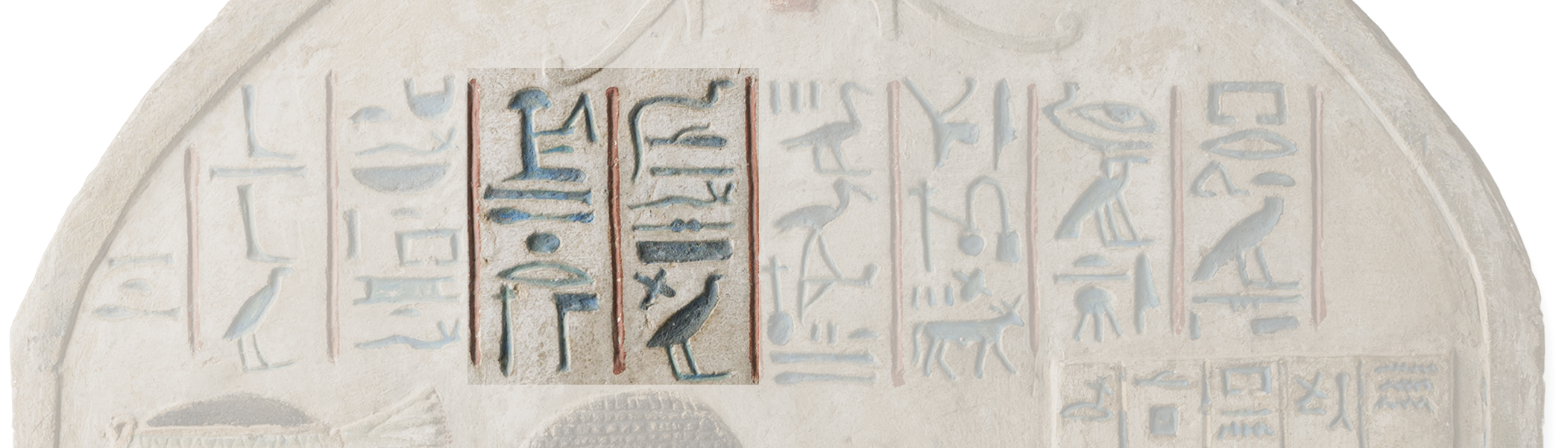
in sS Hsb (n) iHw Apdw DHwty-nfr mAa-xrw
by the scribe, counter (of) cattle and fowl
Djehutynefer, true of voice
 in by – acts as the English prepositionA preposition tells how things relate in space or time. EXAMPLE: “The Ba is in the sky” “by” (of agent); a more traditional spelling of in is
  . New Kingdom inscriptions sometimes use the red crown of Lower Egypt
  instead of the water sign for n.
in is used to introduce the agent of the infinitiveThe infinitive expresses an action in general (to do, to see, to speak). In translation, the -ing (gerund) form (doing, seeing, speaking) may fit better. (the one performing the action). This usage occurs only with nouns; when the agent is a pronoun, it follows the infinitiveThe infinitive expresses an action in general (to do, to see, to speak). In translation, the -ing (gerund) form (doing, seeing, speaking) may fit better. directly, without in.
 sS scribe (title) – sometimes written with a seated man determinativeA determinative is a sign placed at the end of a word to help show what the word means or what kind of thing it refers to.
  . A more correct reading of this word might besXAw.
 Hsb accountant (title) – an agent nounAgent noun is a noun derived from a verb that indicates the person or thing performing the action — essentially, “the doer”. They are often used for professions. derived from the verb
  Hsb “to count” – lit. “one who counts” / “counter”.
 iHw Apdw livestock (and) fowl – plural of the nouns
  iH “bovine” and
  Apd “bird”.
DHwty-nfr Djehutynefer (name) – probably subject + stativeStative is a verb form that describes a state or condition, rather than an action. For example, “he is (in a state of being) happy” or “the door is closed". nfr(.w), meaning “(the god) Thoth is beautiful/good/perfect”.
subject + stativeStative is a verb form that describes a state or condition, rather than an action. For example, “he is (in a state of being) happy” or “the door is closed". expresses a state or a condition of a subject. Since Djehuty (or Thoth) is a masculine singular noun, the stativeStative is a verb form that describes a state or condition, rather than an action. For example, “he is (in a state of being) happy” or “the door is closed". form that follows takes the masculine singular ending .w. This ending is almost never written and we usually don’t transliterate it in names. Djehutynefer thus literally means “Thoth, in a state of being beautiful”.
 mAa-xrw true of voice

Dd n=f sSw mAa-xrw xr nTr aA
called Seshu, true of voice,
before the Great God,
 Dd n=f who is called – passiveThe passive focuses on what happened to someone or something, rather than who did it. “The temple was built” is passive. participle with a pronoun that refers back to the modified noun (Djehutynefer).
passiveThe passive focuses on what happened to someone or something, rather than who did it. “The temple was built” is passive. participle of  Dd, followed by a dativeThe dative tells us to whom or for whom something happens. In Egyptian this is usually marked by the preposition n. (
 n=f) is used to introduce someone’s nickname. Dd n=f literally means “(the one) said to him (Seshu)”.
sSw Seshu (name) – phonetically spelled and ending with the determinativeA determinative is a sign placed at the end of a word to help show what the word means or what kind of thing it refers to. for a person of high rank  (A52).
mAa-xrw true of voice
 xr nTr aA before the Great God – adverbial phrase consisting of a prepositionA preposition tells how things relate in space or time. EXAMPLE: “The Ba is in the sky”
  xr and a noun phrase
  nTr aA (noun “god” with the adjectiveAn adjective is a word that describes a noun, such as “great”, “good”, or “beautiful”. In Egyptian, adjectives usually come after the noun. “great” following it and agreeing in gender and number). The Great God is a divine epithet that usually stands for Osiris in a funerary context.
prepositionA preposition tells how things relate in space or time. EXAMPLE: “The Ba is in the sky” xr can be translated “before” or “near”. It’s often used when expressing a relationship with a deity or a person of a higher ranking, such as the king.
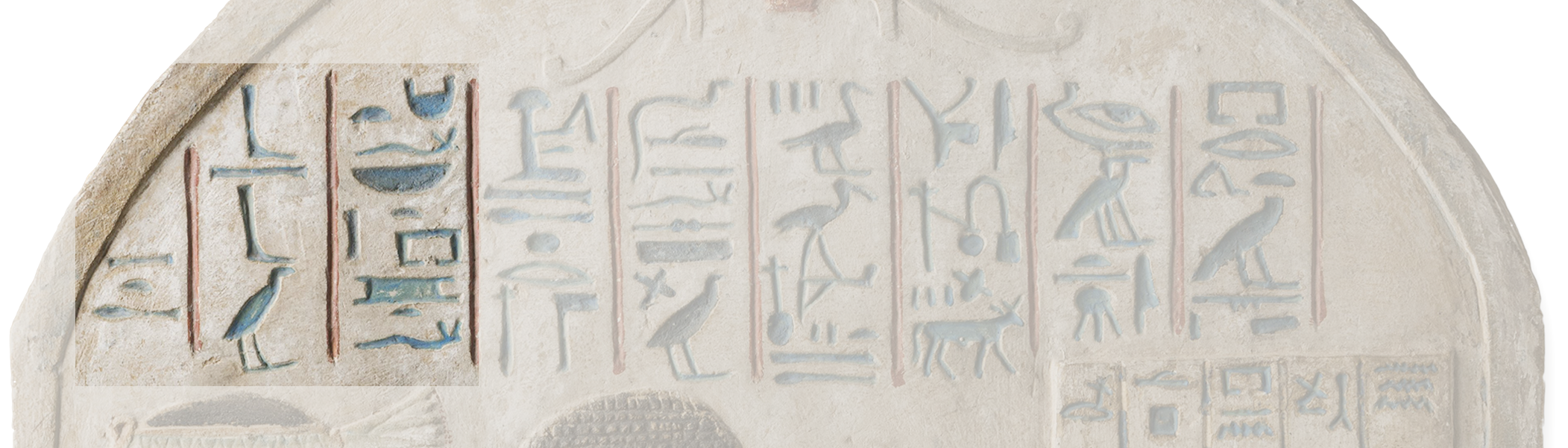

Hmt=f nbt pr mrt=f bnbw mAat-xrw
his wife, lady of the household,
his beloved, Benbu, true of voice.
 Hmt=f his wife
 nbt pr lady of the household (title) – a woman who manages a household / an estate
 mrt=f his beloved – a relative sDm=f;
  is the alternative writing of
  for the mr biliteral.
This is a relative form (or a relative clauseA clause is a group of words that has a subject and a verb. It can be a part of a sentence. EXAMPLE: I sailed upstream because His Majesty had ordered it. with sDm=f). Lit. “(the one) whom he loves”
bnbw Benbu (name) – other objects belonging to Djehutynefer called Seshu show different variants, such as:  bnmb and
  bim.
bim.
 mAat-xrw true of voice – feminine form with a -t ending
Part 2 – LOWER REGISTER
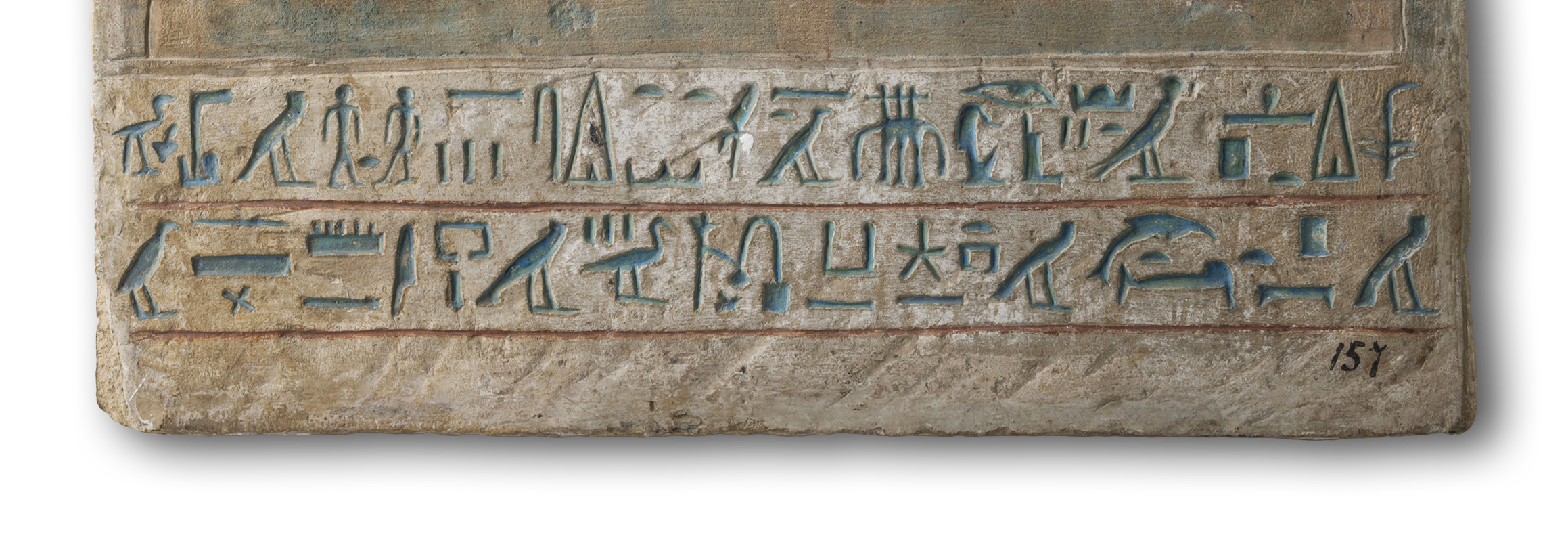

Part 2 coming soon!
bibliography:
- Allen, James P. (2014). Middle Egyptian: An Introduction to the Language and Culture of Hieroglyphs, 3rd Edition. Cambridge University Press.
- Museo Egizio: Collezione online – Stele dello scriba contabile del bestiame e del pollame nel tempio di Ammone Djehutynefer detto Seshu, e di sua moglie, la “signora della casa” Benbu – https://collezioni.museoegizio.it/en-GB/material/Cat_1638/
- Paksi, Julianna (2025). A Case Study on Intertextuality and Textual Transmission from the Mid-Eighteenth Dynasty Theban Necropolis. ZÄS 2025; 152(1): 58–76. De Gruyter.
- Manniche, Lise (1988). Lost Tombs: A Study of Certain Eighteenth Dynasty Monuments in the Theban Necropolis. London and New York: Kegan Paul International.
- https://pnm.uni-mainz.de/5/person/3119
- https://pnm.uni-mainz.de/5/person/3120